
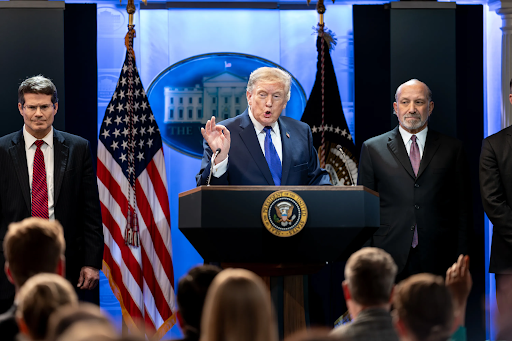
On February 20, the Supreme Court ruled that President Donald Trump’s tariffs were illegal under the “International Emergency Economic Powers Act” (IEEPA). According to the Federal Circuit, who reviewed the case before it went before the Supreme Court, the tariffs are “unbounded in scope, amount, and duration.”
Trump originally established the tariffs due to a “public health crisis” and declared a national emergency because of an influx of illegal drugs coming from Mexico, Canada, and China. These IEEPA tariffs were originally twenty-five percent for Canada and Mexico, and twenty percent on China, meant to curb drug trafficking and illegal immigration.
According to IEEPA, the president is allowed to “investigate, regulate, or prohibit—
(i) any transactions in foreign exchange,” though, they must “consult with Congress before and during the exercise of these authorities.” However, the president posted on his social media website, Truth Social, “As president I do not have to go back to Congress to get approval of Tariffs,” just three days after the Supreme Court ruling.
In retaliation to the ruling striking down his IEEPA tariffs, Trump imposed new tariffs under “Section 122” of the “Trade Act of 1974.” On February 20 Trump said on Truth Social, “It is my great honor to have just signed, from the Oval Office, a Global 10% Tariff on all Countries, which will be effective almost immediately.”
These tariffs specifically target products like steel, aluminium, and foreign-made automobiles, as well as imposing a 10% tariff on all imported goods. Some items not subject to these tariffs are: donations, pharmaceuticals, critical minerals, and United States-Mexico-Canada Agreement (USMCA) compliant goods.
“[Trump’s] put tariffs in place to make it more expensive to buy something from China so that we’re more likely to buy something from America,” says Syd Lott, Skyline’s Economics teacher.
Lott also explains that, with these tariffs placed on China, China will also want to place tariffs on the United States, meaning that the Chinese will also be less likely to buy products from America.
Lott says, “The idea is, you should start a steel factory in America. The problem is a steel factory in America, it takes 10 years to build, and probably won’t be as profitable as the one from China. […] In the long run, that might be a good idea, but right now, in the short run, it’s problematic.”
Since the tariffs went into effect on February 23, steel prices have already risen $70.76 per short ton. “In 2017, […] [Trump] put tariffs on steel under this same law. And what we found was the building of Skyline, the new Skyline, went up about $25 million because of those steel tariffs,” says Lott.
These new tariffs under “Section 122” of the “Trade Act of 1974” are still in their early stages and are legally in effect for a period of 150 days (until July 24). These tariffs are now under review by the Court of International Trade to determine if they will last.
The United States Customs and Border Patrol (CBP) are also required to refund tariffs to anyone who paid them under the IEEPA. According to Justice Brett Kavanaugh, “the United States may be required to refund billions of dollars to importers who paid the IEEPA tariffs.”