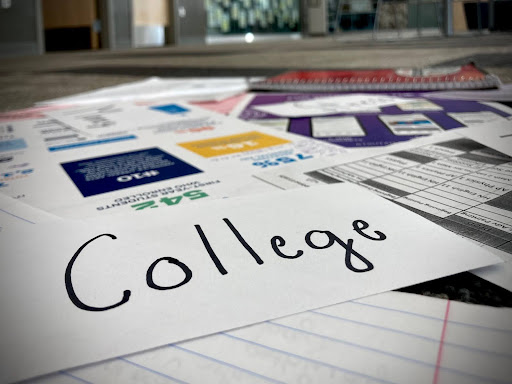
At Skyline High School, forty-five Senior students were surveyed from mostly AP or IB classes and asked about their mental health regarding higher education. 97.8% of the responses stated that “Yes,” they plan to go to college or university after high school.
When asked to rate their stress regarding the college application process from 1 to 5, 40% of students rated themselves a 4 (moderately stressed), 31.1% said 3 (somewhat stressed), and 17.8% said they were a 5 (very stressed). Other ratings at either 1 or 2 were the smallest percentage, with only 2.2% of students reporting to have no stress.
Many students are stressed about similar things related to college. One of these Seniors, Abigail Louder, explains she isn’t getting financial help from her parents and says she’s “mostly stressed about money and affording college.” She also emphasizes the effect uncertainty can have on stress. For her, the lack of knowledge about possible resources she could use to help her pay for college is worrying. She added that, even though she’s pretty confident in what she wants to study, “what if things change?”
Victoria Hatton, Skyline’s School Psychologist, brings some insight on how expectations can affect teens, but especially Seniors.
She says, “Adolescents are very socially driven. […] There is a lot of social pressure to succeed and to thrive in front of other people.” Although this can be common at many ages, the college application season and return letters could be causing a higher level of social strain. Hatton’s view is that a lot of this distress is actually stemming from within, not others. She says, “It’s real, because it’s real to us.”
Skyline is in a part of the Salt Lake Valley that tends to be wealthier than other regions. However, roughly half of students who attend the school commute from out-of-bound areas.
Louder says, “We go to a school with a lot of rich people, so I don’t know if a lot of people are as worried about money.” She feels that, unfortunately, “people that [struggle financially] just opt out of going to college.”
Other external pressure can also intensify this worry in Seniors. For example, Hatton explains, “For some kids, they have family pressure.” Some parents might expect their child to go to a specific college or put financial weight on them to pay for their education.
Hatton then talks about how personal expectations can sometimes cause even more anxiety than the expectations from others.
“When we don’t have the skillset to prepare ourselves for unmet expectations,”people can often “pre-grieve”—Meaning, be devastated about something before it has even happened. Hatton also says, “When there’s a difference between expectation and reality, we feel distress.”
Louder’s advice to upcoming Seniors is to look for ways to pay for college so that debt can be avoided. She emphasizes, “There are scholarships for everything.” She adds that the sheer amount of options can feel overwhelming, but they are “so helpful.”
There is always assistance available, whether it is through the school psychologist, social worker, or administration.
Hatton says, “What I think Seniors in particular need to know is: Asking for help is not a sign of weakness.”