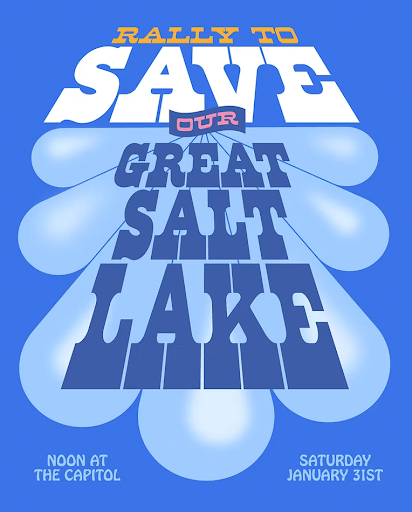
On January 31, approximately one thousand Utahns gathered at the state capitol to urge Utah senators to save the Great Salt Lake from drying up. As water levels in the lake decrease and affect the surrounding environment, environmental activists are educating the public and Utah Legislators about why it is important to try to prevent the lake from drying up.
Organizations such as Save Our Great Salt Lake, Grow the Flow, and Stewardship Utah have been working to return water to the Great Salt Lake by going to the state capitol and gaining support to help their efforts by rallies and social media posts. “By telling that to people who are in power or spreading that information around your community, that’s how you can get involved,” says Alex Rampton, president of the Progressive Action Club (PAC) at Skyline.
The Great Salt Lake is an important part of Utah’s heritage and culture. Many Utah children begin learning about the lake in their elementary school, along with how it has affected its surrounding areas. Donald Dalton, a Science teacher at Skyline High School, says, “The Great Salt Lake is actually a very important ecosystem in the United States.”
Approximately ten million birds come to the Great Salt Lake to rest during their migration flights. The 338 species of birds that stop at the lake come to recharge, tend to their young, and eat the brine shrimp that is plentiful in the Great Salt Lake. “It’s more important that we save the birds and save the people,” says Dalton.
The Great Salt Lake also plays an important role in Utah’s snow output. Having the lake dry up would decrease the amount of snowfall the mountains get, which has already started to happen. “I like to ski, and I don’t want to see 10% of the greatest snow on Earth disappear from our slopes,” says Rampton.
Another effect that the drying of the Great Salt Lake would have is releasing dust containing toxins into the air. “I have my asthma, so […] I struggle to breathe a lot of the times,” said Finley Larson, a Junior at Skyline who attended the protest.
The Great Salt Lake’s water levels have been on a somewhat steady decline since the eighties, but only within the last fifteen to twenty years has it been causing problems with the lake. “The lake is drying up now, because humans are diverting too much water,” said Rampton.
Two hundred million dollars have been donated to organizations such as Ducks Unlimited and Great Salt Lake Rising to allow them to more easily lease water rights, aid infrastructure, and restore habitats.
According to Governor Spencer Cox on his website, “the target is healthier lake levels by 2034. This is a shared effort across state partners, philanthropy, business, and the community.”
Some people are skeptical of this claim that the lake will be restored by the 2034 Olympics. “That’s not gonna happen. […] They’re not gonna focus on it,” says Larson.
Others are more hopeful but still think there is work to be done. Rampton says, “It’s a great commitment, and it’s a great statement to make. Now we got to freaking back it up with the work.”