

Homework, a notoriously known time consumer for students, has grown to be controversial, not only for them but for parents and educators as well.
The National Library of Medicine conducted an experiment where numerous other studies say, “It is possible that the effects of homework are not linear. Some evidence suggests that increasing homework duration can improve academic performance, but there is a point where too much homework can actually lead to a decline in performance.” It is common to hear students complain about their homework amounts, especially when it’s seen as ‘busy work.’
Tate Flowers, a Sophomore at Skyline who averages about three hours of homework per night, says, “I think that might be a bit too much, because quite a few assignments I find unnecessary.” She explains that, if teachers “overload” homework, “you won’t be able to remember what you learn,” and it can become “less effective,” because with more work often comes less effort. If students feel pressured by time constraints and excessive homework, they are more likely to spend less time per assignment, resulting in sloppier work and lower grades.
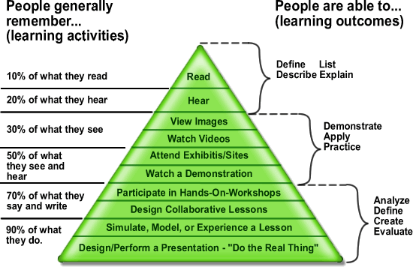 This model, commonly known as the “learning pyramid,” depicts “the upper and lower extremes of the diagram suggest[ing] that we will remember only 10% of what we read, 20% of what we hear… but 90% of what we do” (University of Strathclyde, Glasgow). So, if learning occurs best by action, how much is too much?
Flowers says, for an average Skyline student, a moderate amount of at-home work is about “two hours.” A full high school day consists of a little under eight hours, meaning a hypothetical additional two hours would result in about a ten-hour workday. The U.S Bureau of Labor Statistics shows that, despite education level, adults average roughly eight working hours per weekday. This poses questions about whether teens are held to higher standards than adults are.
One of the most important aspects of education is the curiosity and excitement that should be fostered in learning environments. It is crucial to keep youth involved and motivated to explore their interests. Some argue that immoderate homework limits this sought-after eagerness to learn.
The National Library of Medicine says, “Too much homework can increase […] cognitive load and mental fatigue, leading to decreased motivation and performance. This can cause boredom with homework and learning.” Educators must be aware and willing to notice the effects of their homework and how beneficial it really is for their students. This will positively benefit their students but could also make students more involved and enthusiastic during class hours.
Flowers describes how, when it comes to subjects she likes, homework can make her “more fascinated with it,” while with other classes, she finds it more dull. She says, there are “definitely […] some people” who lose interest in their subject if too much at-home work is assigned. Flowers also believes there is a “positive correlation” between retention rates and homework amount, despite its prosaic qualities at times.
Flowers concludes that although “it’s different for every person, […] finding that happy medium is very important.”