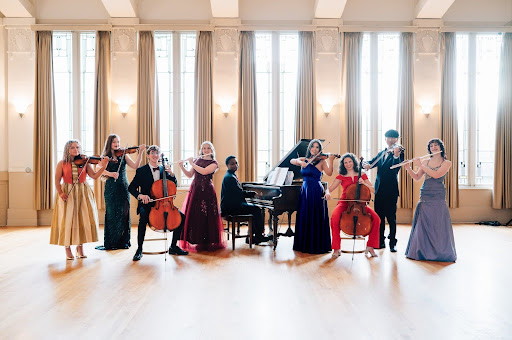
Skyline’s annual Concerto Night featured nine passionate soloists in Wasatch Junior High’s auditorium on March 6. As always, the soloists were accompanied by the Philoharmonic Orchestra and Wind Ensemble to create a magical night of classical music.
Tess Dorius, a flutist, performed Reinecke’s Concerto in D Major. She chose her concerto halfway through her Junior year, seeking advice from former Skyline flute players. Ultimately, however, she found it on “a random Spotify recommendation.” Since she didn’t have a private teacher at that time, Dorius wasn’t able to properly practice until early Senior year, giving her two months to familiarize with it before October’s auditions. “I was fully expecting that I didn’t get in, because I was just so sick the day of,” Dorius explained. “When the results came, I was driving to Oregon with my mom and my boyfriend, and I got the email, and I dropped my phone.” From that point, Dorius dedicated a minimum 30 minutes per day to practicing—oftentimes more. When the performance came, she said, “It felt very supportive and like, warm, almost. So, when I went onstage, I just felt like I was gonna have fun, and I did.”
Violinist Rachel Wall played Vieuxtiemps’ Concerto No. 4 in D Minor, a piece she chose because she “wanted something with depth and […] something super lyrical.” Wall explained that the piece wasn’t her initial choice, as she’d originally been working on a Bruch concerto before switching private teachers near the beginning of Senior year. “We decided to make the [concerto] shift, because [Vieuxtiemps’] was easier,” Wall said. “It still showed depth and impact and technical skill, just in a different way.” Though it gave her less practice before auditions, switching served her well. When Wall got the “pleasant surprise” of being chosen as a soloist, she was able to perfect her piece in rehearsals with the orchestra. Concerto Night naturally brought nerves, but she had become confident in her ability. She said, “I put on my game face, I walked out into the crowd, put a smile on my face. I was ready. […] Everything went great.”
Performing Borne’s Carmen Fantasy, flutist SaraJane Matheson was inspired to audition by watching her sister perform in Concerto Night two years prior. While she joined Band as a Freshman with performing in mind, that experience led her to officially pick her concerto that year. She was shown the piece by her flute teacher. “I was all the sudden so determined to learn it, […] just listening to it and hearing how cool it was,” Matheson says. “It has a very recognizable theme that most people would know, and so I was like, ‘It’d be really cool for people to know what I’m doing.’” After putting in so much effort into the piece, Matheson was “relieved” to have been chosen. She practiced for over an hour a day in the month leading up, but being in Wind Ensemble, she struggled “to be totally locked in” because of limited practices with the orchestra. Still, Matheson said the final performance “felt really good.” She explained, “I was just proud of what I did and what I accomplished, because I have never worked so hard in something in my life.”
Ryli Jonart, a cello player and this year’s Instrumental Music Sterling Scholar, played Dvorak’s Concerto in B Minor. She started thinking about auditioning back in elementary school. She explained, “I went when I was in fifth grade, and I just thought it was like the coolest thing, to get to play with all these people that you know and just play a really cool solo.” Jonart started practicing her concerto about a year before auditions, feeling “really happy” when she was selected. She said, “I was really prepared for it. […] The only definite thing that was hard was just the score. […] The individual sections were quite challenging for each of the different instruments.” The orchestra was resilient, and Jonart said that the actual performance was “really good. I was really happy.”
Bruch’s Concerto No. 1 in G Minor was performed by violinist Elizabeth Mackay. Unlike many other soloists, her piece wasn’t specifically chosen for Concerto Night. “I fell in love with it when I was probably 12. I heard it, and then I just went, ‘I have to play that piece,’” she explained. “I started learning the piece probably three years ago […] [and then I got it] really polished a year ago, because I had a performance for a competition in Carnegie Hall. Like, a smaller hall out there.” When Concerto Night auditions approached, Mackay dusted off her beloved concerto for the big performance opportunity. In her few rehearsals with the orchestra, she focused on getting “more vibrato and push and pull of the tempo” in areas where she desired it to be. Mackay ended up feeling “really great” about the performance. In general, she said, “It was also really fun to hear everyone else play, because there were some pieces that I really love on there. […] Playing the classical, and especially romantic, concertos are my favorite.”
Benjamin Larson played Elgar’s Concerto in E Minor on the cello. For him, it was an opportunity to connect with family. “My cousin played the concerto I played a year earlier, so she kind of had all the stuff, and she could help me,” he said. He prepared the concerto for a year before auditions, but when the results arrived, he was home sick with his mom. He said, “I pulled out my phone, because people were texting me, and then I leaned over to her, and I was like, ‘Oh my gosh, Mom. I made Concerto Night.’ And she just ran around the house, and she was super happy.” For him, rehearsing was “kind of scary” since learning a piece of music of this magnitude and showing it to the whole orchestra is “intimidating.” However, Larson said the Concerto Night performance “went really well.” “I feel so good about it,” he said.
Tess Malmrose showed her violin skill in her performance of Saint-Saens’ Havanaise in E Major. While the Horizon was unfortunately unable to reach her for an interview, Malmrose talked about her best memories with music in preparation for Concerto Night in a promotional post from @skyline.music.council on Instagram. She said that her favorite experience was performing in Italy. While Skyline’s Concerto Night doesn’t involve international travel, both experiences allowed her to show her dedication to crafting music. Like the other soloists, Malmrose put in immense effort to be selected with her solo piece, showing the value and payoff of hard work.
Pianist Jarius McCarthy performed Grieg’s Concerto in A Minor. For him, preparation for auditions was “stressful,” as he started last summer while also working on music college auditions. For the concerto, his piano teacher offered two choices: a Mendelssohn or a Grieg. “I listened to the Mendelssohn for like 20 seconds. I was like, ‘I don’t like this; can we learn the Greig?’” McCarthy explained. “I ended up loving it. It’s a very beautiful piece; it’s very sentimental.” After hard work in rehearsals, he “was very pleased” with the final performance. Since his parents recorded it, he was able to reflect on it retrospectively. He said, “When you’re upstage in front of everyone else, it’s kind of hard to hear the orchestra over your own playing, but when you’re in the actual audience, it’s easier to hear those sounds that don’t necessarily get passed through, which I think it made it a lot more beautiful when you listen back to the recording.”
Playing Kabalevsky’s Concerto in C Major, violinist Daniel Ha found it “very exciting but a little bit nerveracking” knowing he was selected. He said, “I knew that this pressure was coming down on me, but that just pushed me even farther to practice more and get myself ready.” He described rehearsing as “a lot of slow practice […] especially with my piece. It’s very, very fast, so I have to work on getting my fingers up to speed.” Working alongside the orchestra felt natural to him, as he knew his friends would not judge him, and he could see all the effort they were also putting into the performance. For Concerto Night itself, he said, “I think it was the best we could’ve done given the circumstances with like the crazy building.”
For students who are interested in being Concerto Night soloists in the future, these musicians offered advice. Many agreed that starting early was extremely important, followed by having fun and just taking that risk. As Wall stated, “You are an amazing musician. You are capable. You have a shot; don’t think that you don’t.”