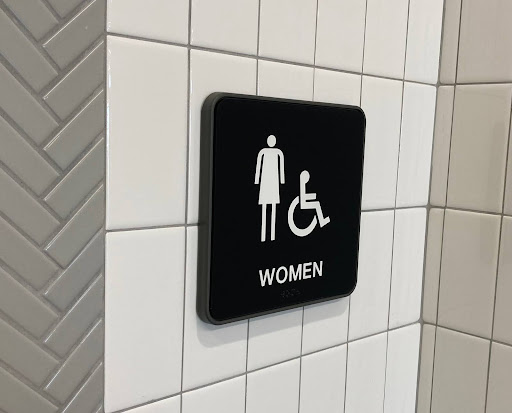
Skyline boys have been asked about their perspective on sexism, stigma, and vandalism due to the inconsistent availability of menstrual products in the building.
Skyline High School has been limiting the amount of menstrual products available in the girls’ bathrooms for years because of alleged “vandalism.” However, female students have said that they have seen little to none of this, which has left confusion and frustration among the student body.
Many girls depend heavily on the school to provide these products, which makes it even more necessary that the school is held accountable.
It wouldn’t be a surprise if the school stressed the fact that period products are offered in the main office to shy away from facing the problem head-on. However, this is only a band-aid that avoids implementing difficult yet vital change.
One of the big flaws of relying on the main office to provide products is the embarrassment and uncomfortable situations students are put through to get them. Even if this resource were without its issues, most students are unaware that this was ever an option. Whether this is simply a lack of open awareness to students or some underlying taboo within the Granite leadership, it is a problem nonetheless.
Although menstrual cycles shouldn’t be seen as taboo, no one wants to shout it from the rooftops either. If products are missing in the restrooms, students are practically forced into that uncomfortable scenario that is not only an inconvenience but a huge breach of privacy.
SBO Secretary, Jarius McCarthy, talks about the discretion around menstrual cycles and says, it makes sense to only share that information with “people you trust.” He also says, the main office is usually meant for “really important things,” and although periods are important, they are also a regular part of life and don’t need to be that publicized.
Students shouldn’t have to go to the restroom, realize the dispensers are empty, then go to the main office, and back. Students deserve the right to some privacy.
McCarthy says, “I think we’re at the age that girls are responsible enough to just take a tampon, do what they need to do, and go.” Most girls have a mutual understanding of what it means to go through periods and wouldn’t want to ruin the access to products for everyone else by vandalizing.
Student RISE Ambassadors have made efforts to help provide more consistent access to products in the bathroom. Signs have been hung up in each stall directing students to email Vice Principal Heather Sonne if the dispenser is empty. Although this is a good idea in theory, it isn’t realistic for some of the same reasons as providing products in the main office. Students might be embarrassed to ask and expose themselves through email, even though it provides more discretion than the main office “solution.” Sonne said herself, she has “received no emails on that.”
The other issue with this is that if girls have an emergency or immediate need for a product, emailing won’t help them. McCarthy emphasizes that we should make a “conscious effort” to make students comfortable and “knowing that their school will provide for them if something like that is to happen.”
Skyline must take responsibility instead of making students responsible for what the school is already legally bound to provide.
Another concern is the education provided about menstrual cycles and sex ed, which seems straightforward but is tied to numerous aspects, like stigma.
Tomo Sato, a Senior, says, “Maturation and menstrual cycle education at our school is lacking and […] that may contribute to some level of stigma because people don’t understand it.”
McCarthy added, “The taboo makes people want to learn about it less, and that in turn creates stigma.” This stigma can be projected on girls and become a reason behind their embarrassment. This cycle is detrimental and will continue unless steps are taken to normalize periods. McCarthy agrees, “We should be more conscious about the way we teach it.”
With lack of education comes ignorance. Much of the health and sex ed curriculum in schools today is severely outdated and biased, not only because of those who created it, but because of Utah and the mentality fostered here.
Liam Greene, another Skyline student, says in regard to education that “there isn’t enough of it.” He adds, “Mormon values and conservative values [are] woven into the curriculum.” These groups tend to emphasize gender roles, modesty, abstinence till marriage, and taboo around bodily functions like menstrual cycles. Although this isn’t the case for everyone, it is common.
It is not a secret that the men’s restroom also faces issues with vandalism, not only with toilet paper and paper towels, but even with food. Greene describes seeing entire rolls of toilet paper being thrown in the toilet as a “clogging mechanism,” as well as paper towels in the sinks and urinals. He says, “Every day there’s some kind of thing.”
Sato, another student who has witnessed vandalism like this in the boys’ bathrooms, talks about the impact on custodians. He says, “I think it’s very disrespectful for people to leave messes like that with the expectation that someone else will clean it up for them.”
Most people would agree that toilet paper is a basic necessity that everyone deserves to have. Hygiene is a human need, which is why bathrooms are expected in public places.
So what makes toilet paper so different from menstrual products?
Is it the fact that only half the population needs tampons? What makes it okay to treat women’s needs as anything less than a human need?
Senior student, Adalayde Scott, brings up the question: “Would the administration choose to let the boys go without toilet paper if there were problems with it, just like they’re letting girls go without menstrual products?”
This parallel points to reasons why one is limited and the other is not. Is prejudice towards girls more pronounced at Skyline than previously thought?
Scott says, “I think it’s rude and apparent sexism, and an assumption that those period products aren’t actually necessary.”
What’s worse? Students aren’t even shocked by Skyline’s response to the issues. Students like Greene and Sato say, respectively, “Unfortunately, I’m not surprised,” and “I think there’s just a poor response to a problem.”
As a woman, this lack of support feels demeaning. McCarthy presses, “If people are still having this taboo about it, I think it goes to show we haven’t done enough.”