
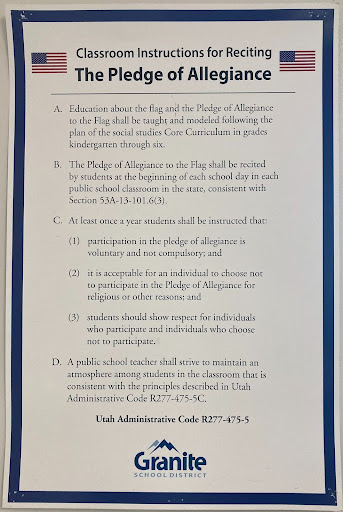
Appropriate signage informing students of their legal rights regarding the Pledge of Allegiance is lacking at Skyline.
Although the Pledge of Allegiance is intended as a non-partisan act of patriotism and loyalty to the United States, some see its ritual or lack of one as a political statement.
Forty-seven of fifty U.S. states currently require the Pledge of Allegiance to be recited in public schools. As a part of this list, Utah has updated its requirements over the years, with its most recent addition being in 2020. The Utah State Legislature goes as follows: The pledge of allegiance should be recited once a day (a), each student should be informed of its optionality (b), and a student can be excused upon written request of their parent.
Although some points might be accurately followed at Skyline, others could be questionable in terms of their actual effect in the school system. In truth, Section C states that a student who wishes not to stand should be excused via parent signature. Many people might not be aware of that part of the code, since many schools don’t strictly enforce it–and rightly so. It isn’t fully clarified how rigid Section C is since steps aren’t being taken to enforce it further.
Although this might be convenient for schools in some ways, other parts of the law could be more problematic if not truly followed.
At least once a year, students are supposed to be instructed that “participation in the pledge of allegiance is voluntary and not compulsory; and not only is it acceptable for someone to choose not to participate in the pledge of allegiance for religious or other reasons, but students should show respect for any student who chooses not to participate” (Section 304).
Section B requires that students be appropriately told via visible signage that their decision to stand is completely their choice and not required by law.
One issue that is prevalent around the entire school is the lack of notices expressing this right. A survey of roughly 90% of classrooms in Skyline was taken to see how many rooms actually had a sign communicating the Utah law. The Career Center, Main Office, and the Commons were included in the final data since they are very “conspicious” areas within the school.
Out of 46 rooms, only four classrooms had a poster on the wall. This 8.7% is sporadic and not apparent enough to effectively make students aware. On top of their appearance being sparse, they aren’t in locations where all students regularly see–only in a few select classrooms. An appropriate example of where one could be would be the bulletin board in the Commons where almost all students pass on a daily basis.
Some teachers mentioned that, while they used to have a sign, they no longer do after the construction and move to the newer building. Although teachers are not mandated to have one in their room, it seems that the old building had more of an abundance. Either signs gathered over the years and got lost, thrown away during the move, or the school used to handle the distribution of these signs more seriously.
Where things could turn problematic is if students are standing for the wrong reasons. Another survey of 134 students was conducted using six independent classes of a variety of grade levels.
Each student was asked two multiple choice questions; 1. “Do you stand for the Pledge of Allegiance in school?” (yes/no); and 2. “If so, why do you stand?” The options included “genuine pride in my country,” “because everyone else is/social pressure,” or “habit/routine.” Out of all participants, roughly 56% of students stated “yes,” they do stand.
Of that percentage, ~25.3% said for genuine pride in their country, ~17.2% said out of habit or routine, ~6% said both pride and habit, ~3.7% said due to pressure, and the remaining ~3.7% had varying combinations.
So the question is, do students really know what they are standing for? Some interpreted pride in the current state of the country while others specified otherwise. Sophomore student Lydia Bartholomew says, “I’m proud of what this country hypothetically stands for, which is liberty and equality for all, [but] I think often the United States struggles to match that philosophy with our government’s actions.”
With the change in government administration, many people questioned their participation in the Pledge of Allegiance. Bartholomew says, “I have thought about it especially in light of recent events. […] When I was younger, it was more [of a] habit but now that I’m more aware of current events, I’ve been thinking about ‘why do I stand for the pledge? Am I genuinely proud of what this country is doing right now?’”
Bartholomew also says that she doesn’t think that she has “ever seen a teacher who hasn’t stood.” Although they have the right to not stand, the majority of teachers do, perhaps because it is somewhat expected of them since they must keep their own personal beliefs outside the school environment. Bartholomew continues, “I have had teachers who kind of insinuate that it would be a good thing for you to stand,” which contradicts the intended neutrality schools should have on matters like this.
Whether standing or not acts as a political statement is up to debate. Some might say that because so many people do and it’s meant to be non-partisan, it is more of a political statement when someone does not stand. However, others might argue that when someone stands, they are supporting the United States’ actions, which not everyone agrees with.
There are numerous ways to interpret the Pledge of Allegiance. Even though someone might not support the current state of the U.S., they might be standing in honor to the country’s veterans for example.
It’s important to not show immediate judgement to others when someone has a different choice, because one of their reasons might just align with something they never previously considered. One anonymous teacher said that when a student says the Pledge of Allegiance, they don’t have to just be saying it to the country but also to their fellow classmates.
Although a student might agree with “liberty and justice for all,” they might not agree with “under God,” which can be debated as a violation of separation of church and state.
Even though a student can be patriotic, Bartholomew says, “If you’re so patriotic to the point where you don’t think your country can do any wrong, that’s a serious issue.” She describes that there is a big difference between patriotism and nationalism and says that “there’s this whole concept of American exceptionalism,” which describes the idea that the United States is unique or exemplary compared to other countries.
Bartholomew gives the example of thinking “bad things can’t happen to us [or] we are the example of democracy to the world.” She says, “I think it’s good to be proud of what your country has accomplished but also recognize there are some serious […] and systemic issues.”
When students were surveyed, it was important to include a mix of grades because of how different ages might interpret the Pledge of Allegiance. From a young age, students are taught to stand when the anthem is played or the flag is shown. Many kids really only understand it later on in their childhood. Although some might grasp what it says, do they really understand the connections and possible implications of its words?
Bartholomew says, “I don’t think it’s a good thing for you to be standing up constantly and saying something every day when you don’t actually understand the meaning behind your words.” She says that part of the reason it’s a habit for so many people is because “it’s kind of been drilled into you your whole life.”
So, is this something that should be ingrained so early on when many kids can’t fully comprehend if what they’re being taught is true to their beliefs?
This issue might cause some to rethink, as Bartholomew offers the thought, “What kind of message am I sending?”